EN
EN
 AR
AR
 CS
CS
 DA
DA
 NL
NL
 FI
FI
 FR
FR
 DE
DE
 EL
EL
 HI
HI
 IT
IT
 JA
JA
 KO
KO
 PL
PL
 PT
PT
 RU
RU
 ES
ES
 SV
SV
 IW
IW
 ID
ID
 LV
LV
 LT
LT
 SR
SR
 SK
SK
 SL
SL
 UK
UK
 VI
VI
 ET
ET
 HU
HU
 MT
MT
 TH
TH
 TR
TR
 FA
FA
 MS
MS
 GA
GA
 HY
HY
 UR
UR
 BN
BN
 GU
GU
 TA
TA






The Unsung Hero of Energy-Efficient Glass: Insulating Glass Molecular Sieve
In modern energy-efficient buildings, insulating glass has become the standard for windows, doors and curtain walls. We often marvel at its clarity and thermal insulation, yet rarely notice the "unsung hero" working silently within the interlayer—the insulating glass molecular sieve. These tiny crystalline particles are what ensure decades of consistent clarity and stability for insulating glass.
What is an Insulating Glass Molecular Sieve?
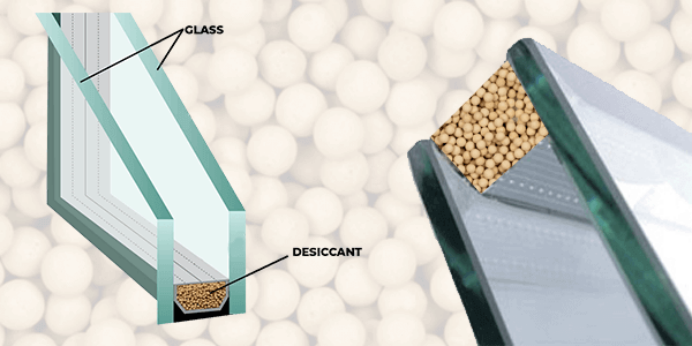
The specialized molecular sieve for insulating glass is primarily Type 3A, a crystalline aluminosilicate. It features a highly ordered, uniform microporous structure with a precise pore size of approximately 3 angstroms (Å, 0.3 nanometers). Typically appearing as white or pale yellow spherical beads, these unassuming particles are internally filled with nanoscale "pockets", making them highly efficient desiccants engineered specifically for insulating glass.
Core Functions: Anti-Fogging, Pressure Stabilization & Lifespan Extension
The most common failure of insulating glass is internal fogging and condensation. The core mission of the molecular sieve is to adsorb moisture and residual volatile organic compounds (VOCs) within the cavity. Its 3Å pore size perfectly accommodates 2.6Å water molecules while blocking larger air molecules (3.4Å oxygen and 3.6Å nitrogen). This selective adsorption ensures only water is absorbed, maintaining an ultra-dry environment that prevents fogging even at -40°C.
Pressure Balancing & Breakage Prevention
Seasonal and diurnal temperature fluctuations cause the gas inside insulating glass to expand and contract, creating significant pressure differences that can distort or even shatter the glass. High-quality molecular sieves dynamically balance internal pressure by steadily adsorbing and desorbing trace moisture, acting as a "shock absorber" to counteract pressure stress and protect the glass structure.
Component Protection & Lifespan Extension
With a stable, mildly alkaline pH (≈10.5), molecular sieves are chemically inert and won't corrode aluminum spacers or sealants. They permanently inhibit moisture-induced degradation, slowing seal system aging and extending the service life of insulating glass from a few years to 15-20 years or more.
Why Type 3A is the Industry Standard?
Industry standards (JC/T 2071-2011) mandate Type 3A molecular sieve as the only desiccant for insulating glass. Compared to silica gel, mineral desiccants, or Type 4A sieves, 3A offers irreplaceable advantages:
- Low-Temperature Efficiency: Maintains full adsorption capacity below 0°C, where ordinary desiccants fail drastically
- Ultra-Low Dew Point: Stabilizes internal dew point below -40°C
- No Desorption: Physical adsorption prevents "water back-release" at high temperatures, ensuring lifelong stability
- Eco-Safe: Purely physical action, non-toxic and environmentally friendly
A tiny molecular sieve particle is a cornerstone of building energy efficiency. Through its exquisite microstructure, it safeguards the comfort and energy performance of entire buildings. When choosing high-quality insulating glass, always verify it uses GB/T 10504 compliant Type 3A molecular sieve—the core guarantee for long-lasting clarity, stability, and efficiency.